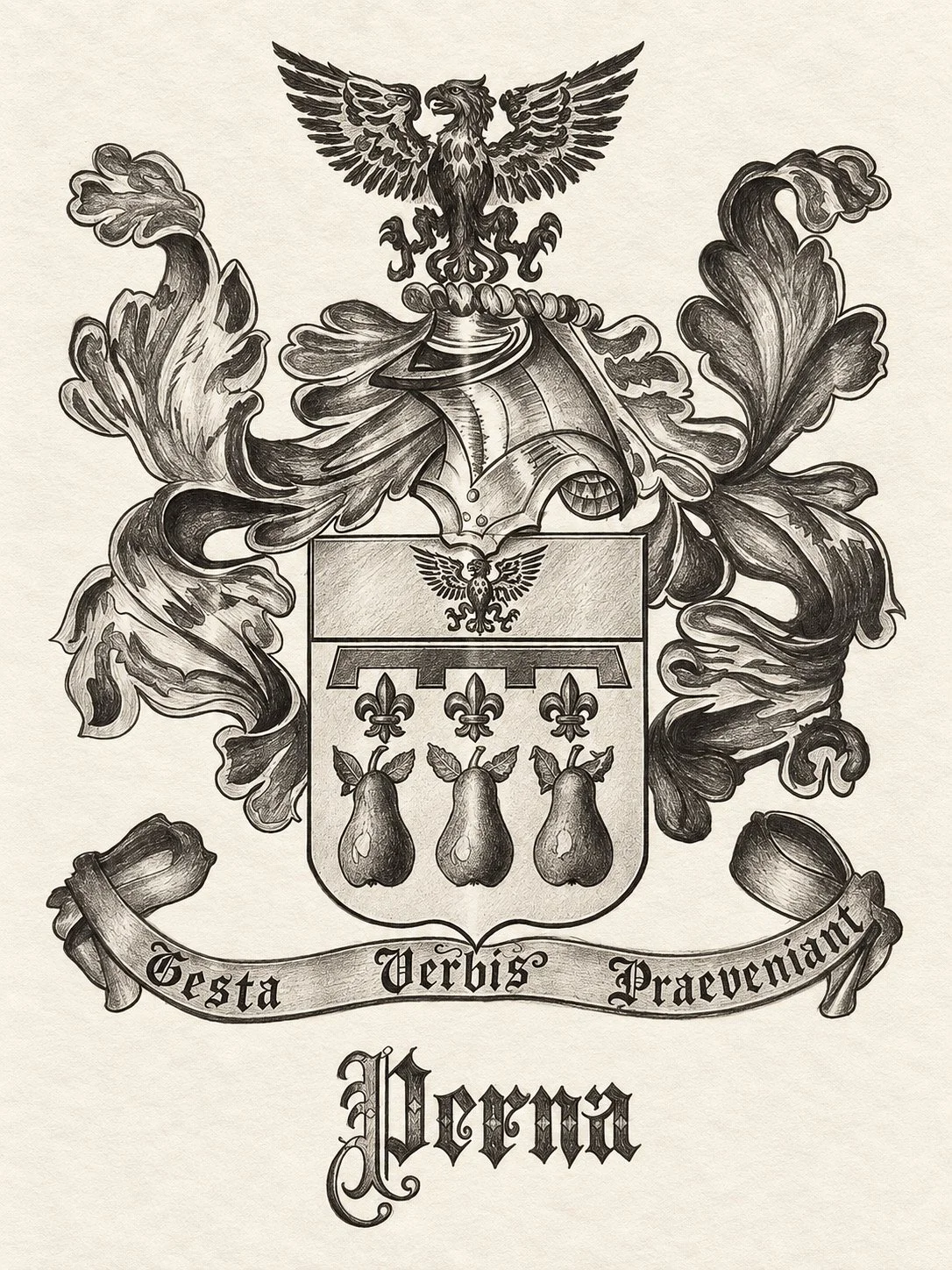
Growing up, there was an image of our family coat of arms hanging in my father’s living room. I knew it belonged to our family, but I did not fully understand what I was looking at.
Years later, I photographed it and reproduced it by hand in graphite. I spent hours studying its shapes, its shadows, and its intricate details. Through deliberate, emotional pencil strokes, I explored the drama of light against darkness. Drawing became a way of looking more closely—and looking more closely led me into research.
In Italian, it is a stemma di famiglia: a family coat of arms.
Our family comes from Campania. In more recent generations, we were traditionally stonemasons. My connection to this image comes through the people I knew: their strength, their work, their loyalty, and their determination.
The words beneath the shield
My father understood the motto as “Actions speak louder than words.”
The inscription reads: Gesta verbis praeveniant. Its translation is “Let deeds precede words.”
Gesta means deeds or things accomplished; verbis refers to words; praeveniant expresses “let them precede.”
My father’s interpretation captured its spirit. The Latin asks us to put that principle into practice: act, and let your actions carry the meaning.
Reading the heraldry
The complete design includes the shield, helmet, surrounding mantling, and the eagle above it. Technically, the figure above the helmet is the crest, or cimiero in Italian. The twisted band beneath it is the torse; the flowing forms surrounding the helmet are mantling.
A chief, or capo, is the upper section of a shield. The small eagle in this drawing may suggest an imperial chief, although the original colors and a written heraldic description would be needed to establish that.
Below it, the horizontal device with hanging points resembles a heraldic label, called a lambello or rastello in Italian. What I remembered as three straps appears to be a label with four descending points framing three fleurs-de-lis.
That arrangement resembles the capo d’Angiò, the Anjou chief, traditionally combining three gold fleurs-de-lis with a red label on a blue field. In Italian heraldry, this device had associations with Angevin recognition and Guelph allegiance to the papal side.
This opens a window onto the political and religious history of southern Italy. Angevin rule began in 1266, and the dynasty’s history extended into the fifteenth century. Campania, with Naples at its center, belonged to that world of royal power, papal influence, alliances, and contested succession. The symbolism therefore has medieval roots reaching toward the Renaissance. I do not have a document establishing when these particular arms entered our family’s history.
When I researched the drawing decades ago, I remember finding an association between the straps and acts of valor in close combat on the battlefield. I also remember understanding the three pears as representing three brothers.
Those are recollections of my earlier research. Heraldic symbols do not have one universal meaning that applies to every family, and I have not yet recovered the sources behind those interpretations. But they were part of what drew me into the image—and into the question of how family character is carried across generations.
Uncle Giuseppe: returning to the front
For me, the connection to acts of valor becomes tangible in my Uncle Giuseppe, whom we called Uncle Joe—my father’s oldest brother.
My uncle, my father, and many of my cousins volunteered during World War II.
Uncle Joe was an Army infantryman. He was shot twice, on two separate occasions. The first time, he was shot in the buttocks. He went to the hospital, recovered, and returned to the front lines. Then he was shot in the leg. Again, he went to the hospital, recovered, and returned to the front lines. He survived both shootings and went back into combat a third time.
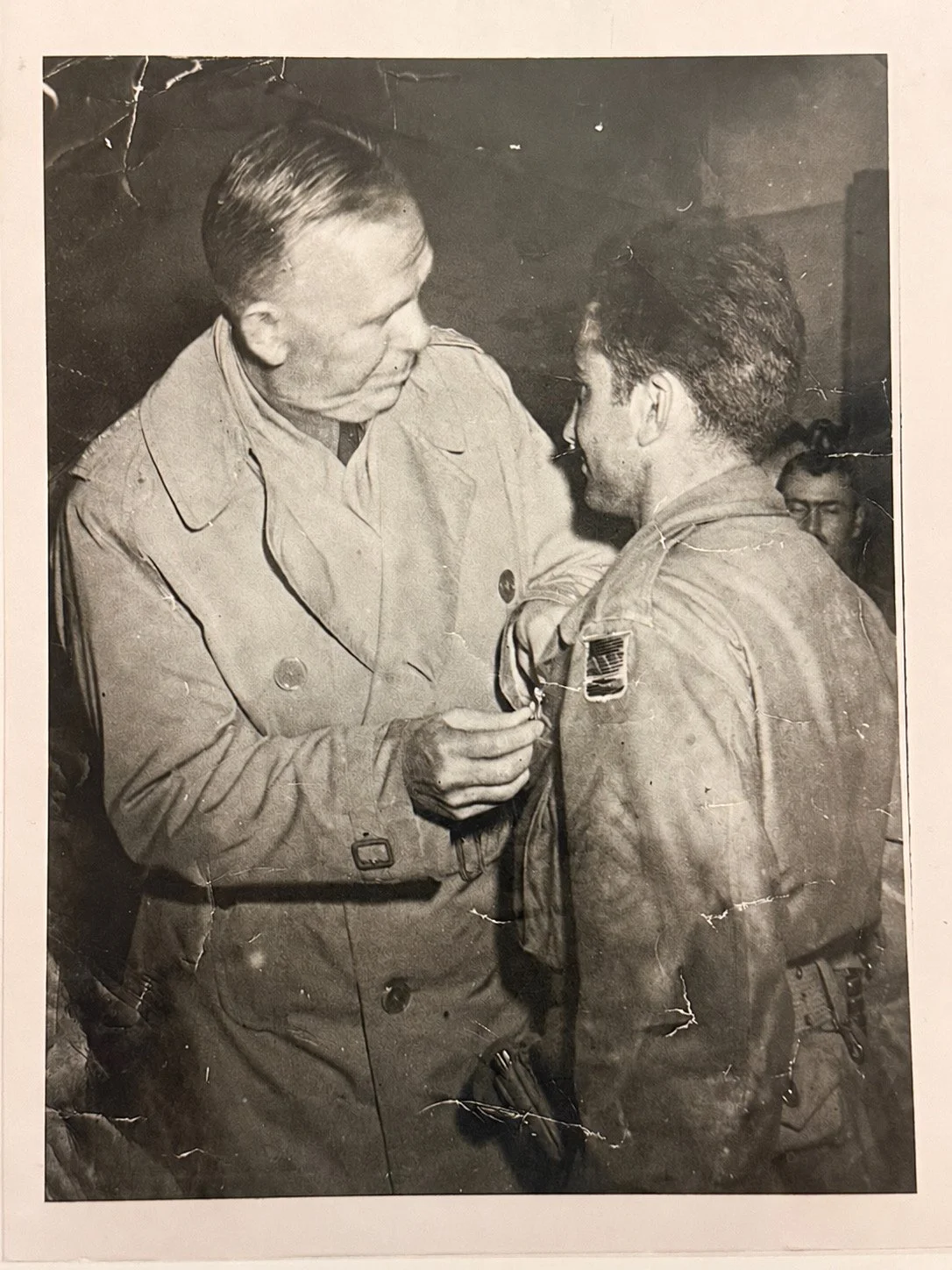
The military record identifies him as Staff Sergeant Joseph T. Perna, Company K, 319th Infantry Regiment, 80th Infantry Division. His Silver Star was awarded for gallantry in action in France on September 8, 1944, recorded in General Orders No. 53, dated October 10, 1944. The surviving order establishes the award and date of his gallantry; it does not describe the full action behind it.
Read the original Silver Star order.
Our family identifies the accompanying photograph as the moment General George C. Marshall presented Uncle Joe with his Silver Star.
His regiment subsequently fought in the Battle of the Bulge during December 1944 and January 1945. In my family’s account, Uncle Joe was there too. His regiment’s participation is documented; his individual movements during that campaign remain something I would like to establish more precisely.
Explore the 80th Infantry Division’s historical archive.
My father: carrying the weight of the war
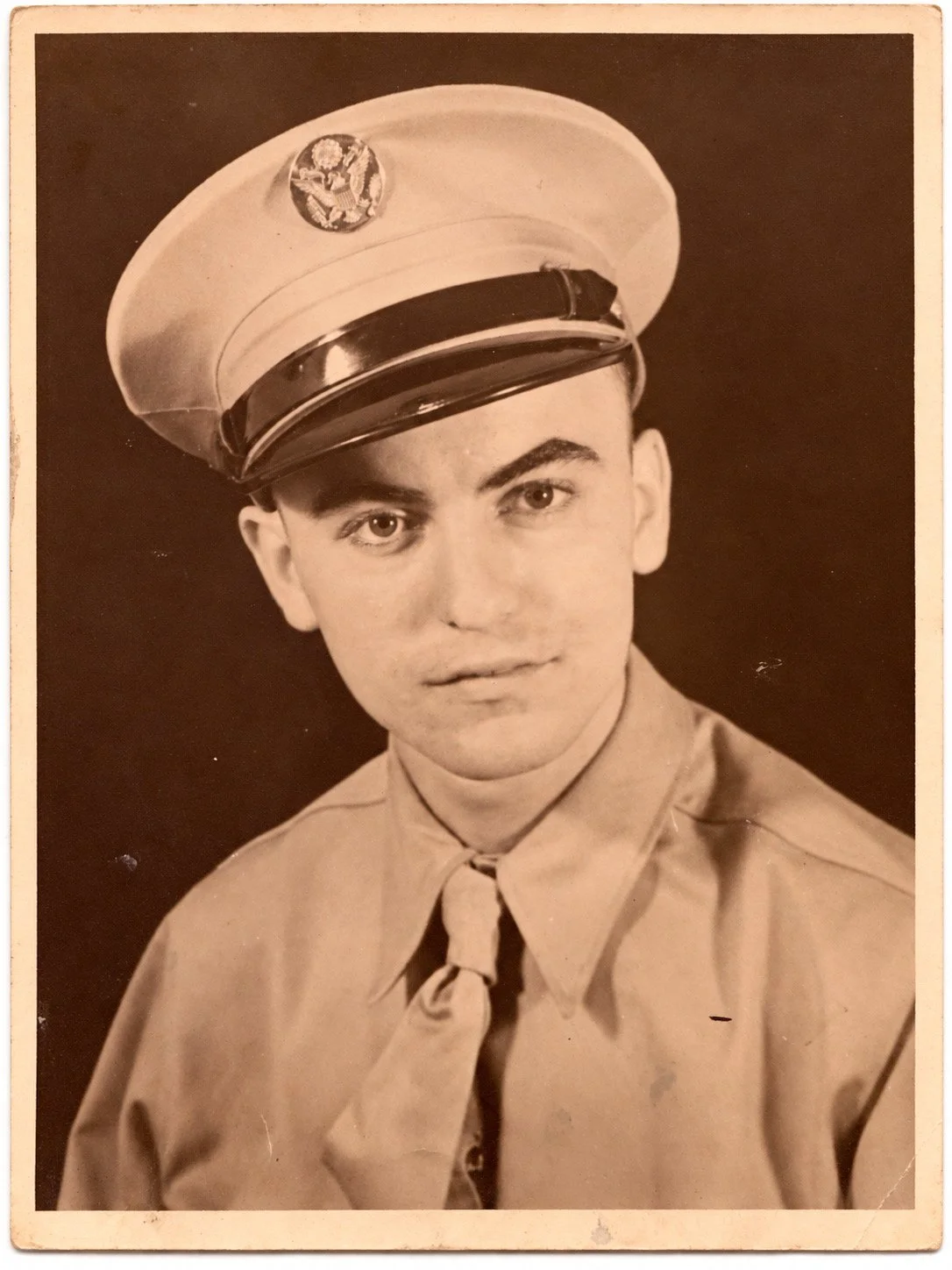
My father, Daniele Anthony Perna, grew up in Overbrook, Philadelphia. During World War II, he served in the United States Army Air Forces, stationed in England.
His work was grueling. As he described it to me, he processed the bodies of servicemen coming from the front: removing their gear, collecting their belongings, placing their bodies in bags, and tagging them. He dealt continuously with the physical aftermath of war.
The exact name of his unit or detachment has not yet been established. The duties he described overlap with the wider military system of Graves Registration, administered through the Army’s Quartermaster organization. Its responsibilities included caring for the dead, establishing identification and burial records, and collecting and documenting personal effects.
The Army’s January 1945 Graves Registration manual gives some sense of the precision this work demanded. Personal belongings were inventoried, labeled, and secured so they could be accounted for and returned through the proper channels. Behind those procedures were people whose identities and possessions had to be treated with care.
I heard my father’s story when I was young, and I do not remember every detail of the transport arrangements. The broader return of American war dead to the United States became a major postwar undertaking, including transport by ship. I cannot say which part of that process my father personally handled.
What I remember clearly is the work itself. To face those bodies day after day required a kind of courage that deserves recognition. I believe what my father did took heroism, and that it deserved an award.
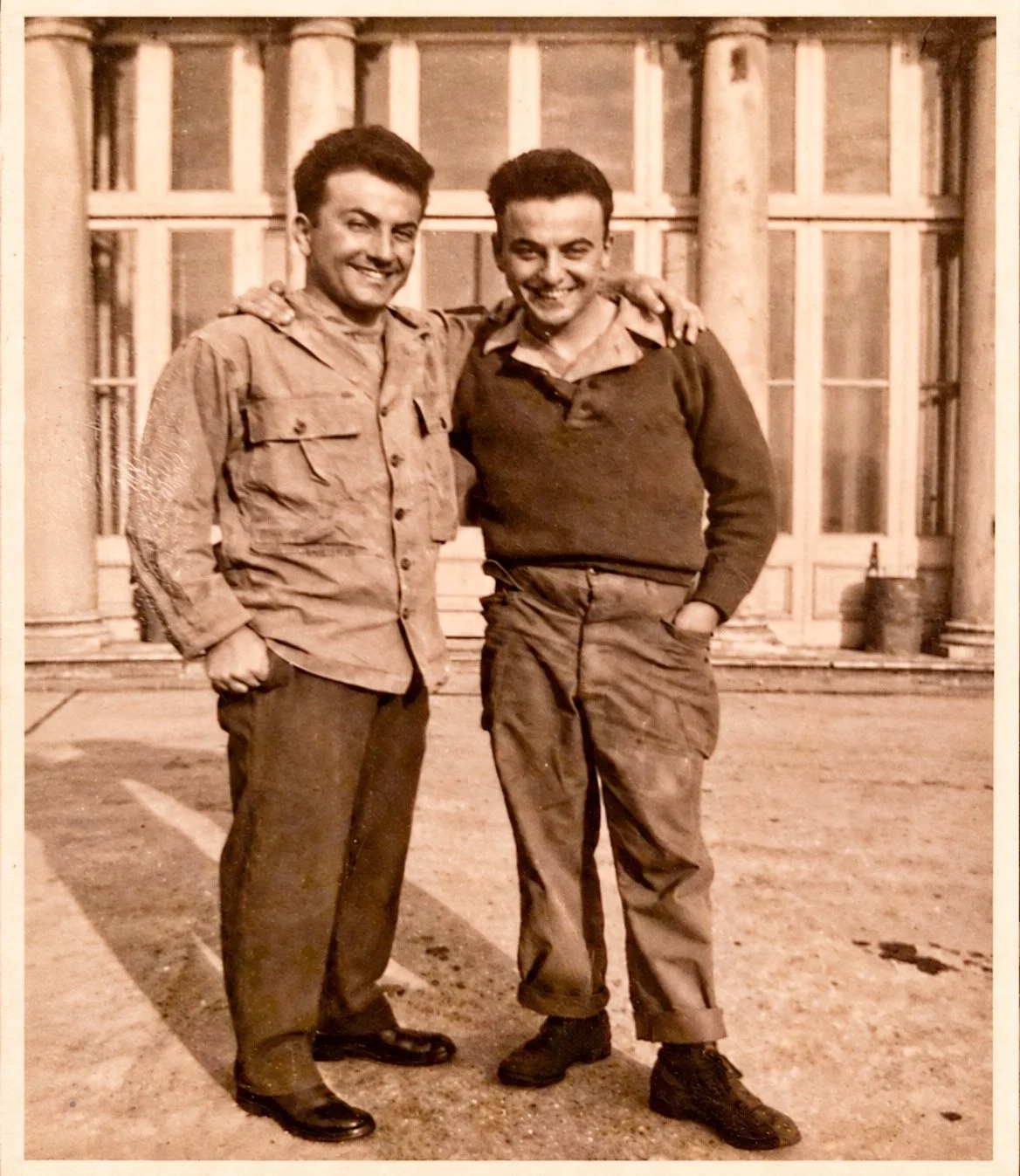
Another photograph shows my father and Uncle Giuseppe together during the war in the European theater. I do not know the exact date or location. What survives is a moment of connection between two brothers whose experiences of the war were profoundly different.
What the drawing means to me
I see a continuity between the stonemasons in our family, my uncle’s courage on the battlefield, my father’s endurance in England, and the determination I have seen in our family in business, in law, and in everyday life.
They were fighters—sometimes with their bodies, sometimes with their minds.
When I drew this coat of arms, I was studying an image. Looking at it now, I am also looking at the people behind it.
The deliberate, emotional pencil strokes carry something of my own hand. The story carries something of theirs.
Gesta verbis praeveniant.