CASE STUDY
Sculpting a Living Interior
Upper West Side, New York City
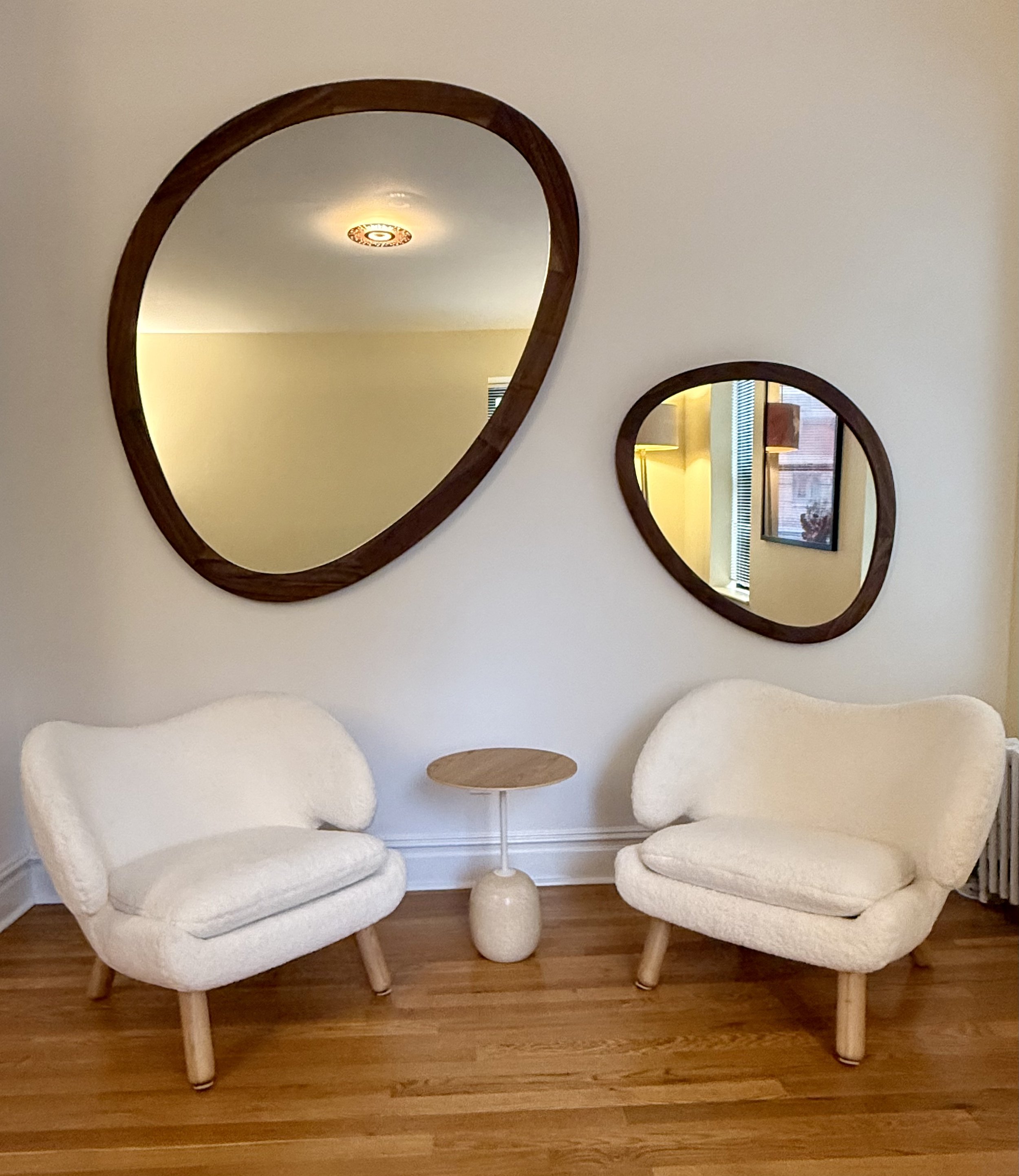
When a private client on the Upper West Side—a lawyer, educator, and mother with a refined sensitivity to her surroundings—engaged Daniele Perna Designs, the work began not with style, but with listening. Through the principles of Living Design, the process focused on understanding how she responds to space: what calms her, what stimulates her, and what allows her to feel most herself at home. The objective was not to impose a look, but to identify her sensibility and bring it fully into form.
The living room presented a familiar New York City condition. Modestly scaled and strictly rectilinear, the space was essentially a box—well proportioned, but visually rigid. The challenge was not simply to furnish the room, but to release it from its geometry.
An early shift came through a curved, generous sofa upholstered in blue-toned Italian faux fur. Where the architecture was rigid, the sofa was yielding; where the room was defined by right angles, it introduced continuous movement. Its texture softened the atmosphere, its color added quiet depth, and its form began to re-educate the space—signaling that this interior would be shaped by feeling and flow rather than strict alignment.
As one moves through the room, white bouclé-upholstered Pelican chairs, non-rectilinear coffee and side tables, and other sculptural forms reinforce this emerging language of softness and movement. Still, one surface resisted transformation: a long, flat wall whose rectilinear presence held the room in place.
Addressing that surface required more than intuition. The composition began with a precisely developed architectural elevation—drawn with exact dimensions, reference points, and proportional relationships—so the arrangement could be measured, located, and verified directly on the wall before any physical installation began. The elevation functioned as a working framework, allowing each element’s position, angle, and relationship to be established with precision.
The solution took the form of two made-to-order Italian mirrors, fabricated in high-end glass and set within custom-crafted walnut frames. These pieces did not exist prior to the design decision. Once the elevation was finalized, the mirrors were commissioned specifically for this installation. Production, finishing, and international transport extended the timeline to approximately four months before delivery. As is customary with work of this caliber, the commission required full payment upfront—underscoring that this was a deliberate, committed decision rather than a reversible selection.
Once the mirrors arrived, the project moved from drawing to execution. This was not a conventional installation. Both mirrors were substantial, highly crafted, and very heavy, requiring a coordinated and methodical approach. Each piece was engineered with an internal mounting system designed to lock precisely onto a corresponding wall-mounted bracket. Translating the elevation into the physical wall required careful identification of structure behind the drywall, including the precise location of studs and load-bearing points to ensure absolute stability and safety.
In the case of the larger mirror, the installation required four people working in coordinated sequence to lift, align, and engage the internal bracket cleanly onto the wall-mounted plate. Because of the mirror’s weight, cost, and the precision required at the moment of engagement, the process had to be carefully orchestrated. The work unfolded through measured movements and constant verification, ensuring that each piece seated correctly without stress or misalignment.
This moment clarified why the installation required a single guiding intelligence—someone responsible not just for execution, but for sequencing, judgment, and accountability across every step of the process.
The result moved beyond interior decoration altogether, registering instead as a sculptural art installation—one that reshapes the room rather than simply inhabiting it.
“I make it happen somehow in the mind’s eye—in the pineal gland—and in the reflection of the universe into my soul. I love taking art, sculpture, interior architecture, and creating a vision that stimulates my client, and stimulates the other humans who will inhabit it.”
— Daniele Perna
Daniele Perna is not a decorator. He is not even just a designer, nor an architect. He is someone who sees structure as a field, and then quietly reshapes it so his clients, family members, friends, and guests can live inside that perception without needing language for it.