
Photorealistic design rendering of the Harley-Davidson Pan America 1250, illustrating the proposed intervention—cobalt field with selective copper articulation.
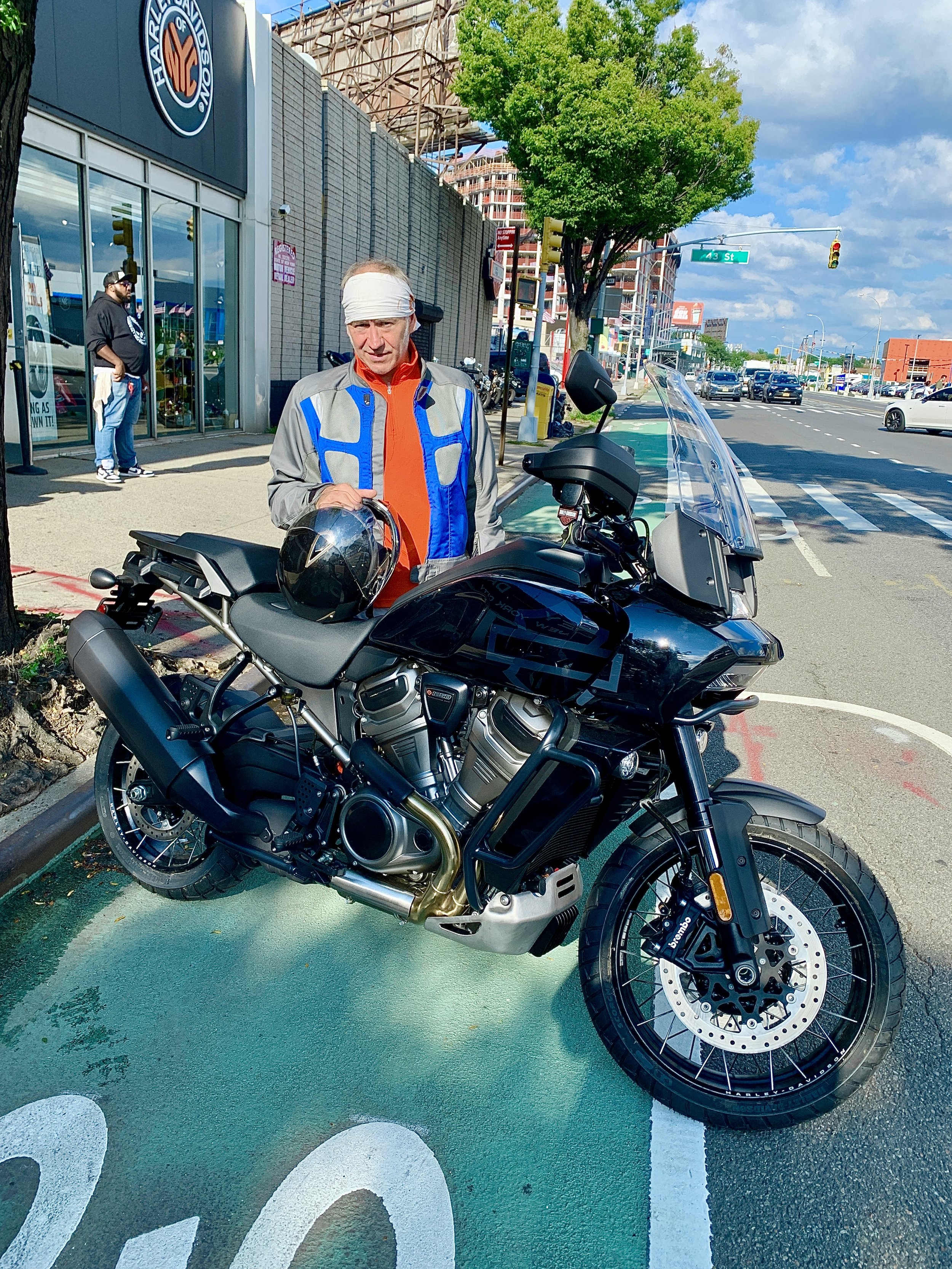
Original photograph of the Harley-Davidson Pan America 1250 captured immediately following a test ride in New York City, documenting the factory-spec motorcycle.
INTRODUCTION
A focused design intervention on the Harley-Davidson Pan America 1250, developed through direct riding and evaluation.
This work is part of an ongoing personal process to identify and configure a new adventure motorcycle for my own use, with a specific focus on performance, durability, and adaptability in Telluride, Colorado and the surrounding San Juan Mountains. Multiple platforms are being tested in real conditions where terrain, elevation, and environment demand both mechanical reliability and clarity of operation.
Following direct experience with the Pan America 1250 in New York City, this design was developed as a photorealistic rendering—an applied vision of how the motorcycle will be refined to align with my design language while anticipating its use in high-altitude mountain terrain.
The images presented include a photorealistic rendering of the intended design intervention, alongside an original photograph of the motorcycle in its factory condition, taken by the Harley-Davidson sales representative immediately following a test ride in New York City.
BASE PLATFORM
Base platform: Harley-Davidson Pan America 1250
Engine: 1252cc Revolution Max V-Twin, liquid-cooled
Output: approximately 150 horsepower
Torque: approximately 94 lb-ft
Transmission: 6-speed
Chassis: steel trellis frame, engine as stressed member
Front suspension: inverted fork
Rear suspension: monoshock
Category: Adventure Touring
DESIGN OBJECTIVE
The objective is not to redesign the motorcycle, but to clarify its visual system—reducing noise and strengthening coherence through controlled decisions in color, proportion, and surface.
This is not a speculative concept or fantasy object. The intervention presented here represents the intended future build configuration for personal use in Telluride, Colorado and the greater San Juan Mountain region.
COLOR SYSTEM
Color is used here as a structural device, not decoration. Cobalt establishes the primary field condition, creating a unified visual presence that holds across varying light conditions and environments, while also being selectively used for articulation within the system.
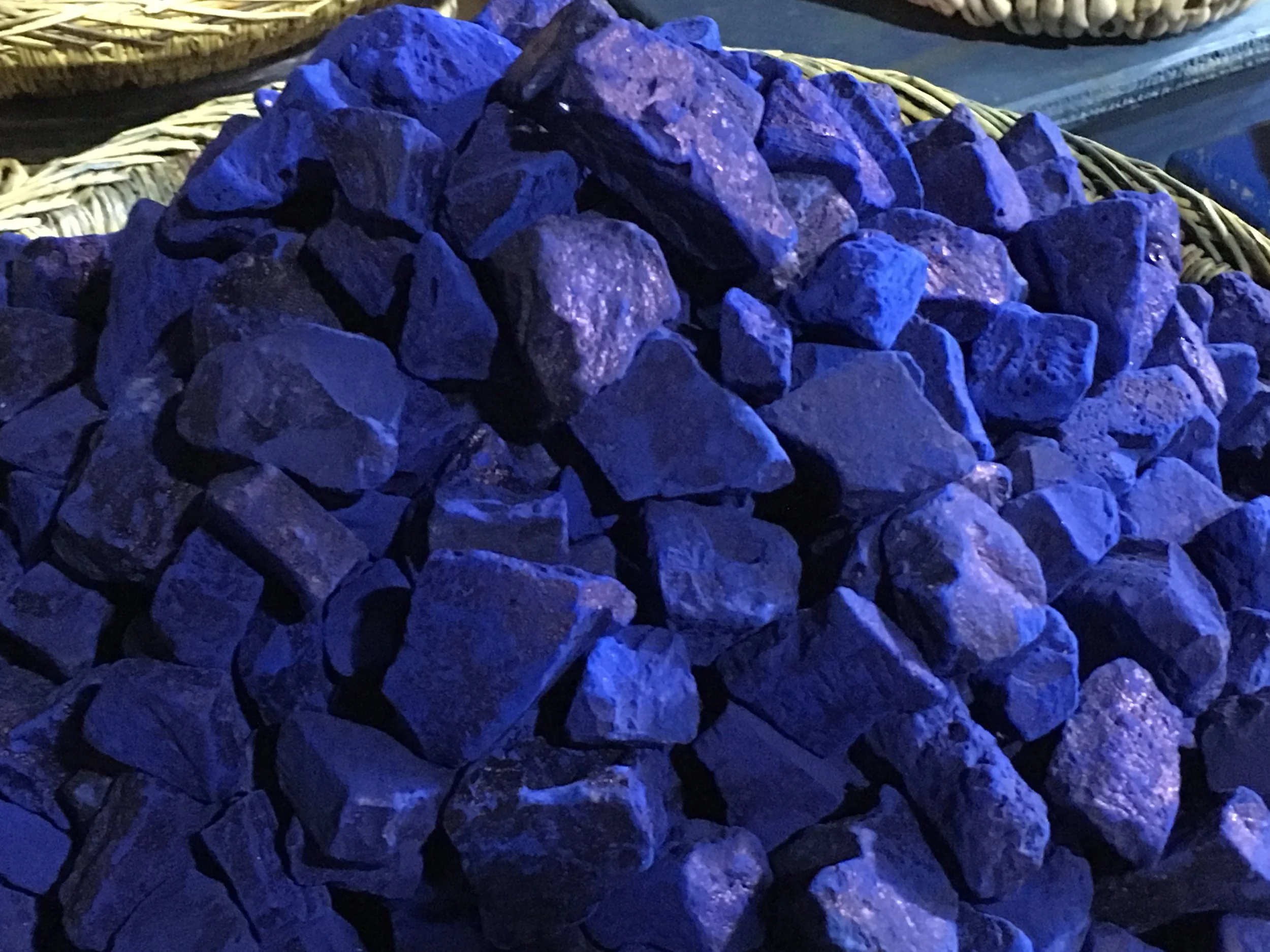
COBALT PIGMENT Marrakesh, Morocco. Raw cobalt pigment photographed while traveling through Morocco.
The use of cobalt is informed by direct observation. While traveling in Marrakesh, Morocco, I encountered cobalt pigment in its raw, refined form—dry, granular, and intensely saturated. Seeing the material outside of application, as a substance rather than a finish, established a clearer understanding of its density and visual weight. This experience informs its use here as a primary field condition.
Cobalt is derived from the Periodic Table of Elements (Co) and is historically tied to pigment production, with a strong presence in Morocco and across parts of Africa where cobalt ore is mined and refined into deep blue pigments used in ceramics, textiles, and architecture. It also plays a critical role in contemporary energy systems, particularly in battery technology, linking the material to stored energy and latent power.
Copper—also derived from the Periodic Table (Cu)—is introduced as a complementary material expression. Where cobalt establishes the field, copper functions as articulation. Its role as a conductor in electrical systems informs its application: selective, directional, and precise.
MATERIAL ARTICULATION
Expressed as a warm, golden tone, copper is applied to key structural and mechanical elements:
Wheel rims are finished in golden copper, grounding the visual mass
Front fork outer housings are treated in copper, establishing vertical continuity
A diagonal, rounded tubular structural member is articulated in copper, emphasizing the chassis geometry and directional load path
The REX 7 graphic is applied as a controlled overlay, scaled to support the form without dominating it
ENGINE INTERVENTION
The engine remains predominantly unaltered, preserving material honesty and mechanical integrity. Select interventions are applied with restraint.
On the V-twin engine, one rectangular component on each cylinder is articulated in cobalt blue, while the corresponding component on the opposite side is left in its natural finish. This deliberate asymmetry introduces controlled tension and balance, avoiding mirrored repetition while preserving the integrity of the mechanical core.
Additional detailing is introduced around the engine cap, where subtle cobalt accents reinforce the overall field condition without overwhelming the system.
GRAPHIC SYSTEM — REX 7
REX 7 functions as a graphic element within the system while carrying a defined meaning.
“Rex” is derived from Latin, translating to “king.” The number “7” is used as a constant—associated with completeness, clarity, and resolution. In Sanskrit, the word “sapta” denotes seven and appears in foundational structures tied to cyclical patterns and repetition.
In numerological interpretation, 7 is associated with introspection, analysis, and the search for underlying truth. Within this context, it can be understood as a “lifter of illusions,” aligning with the intent to clarify form and strip away visual noise.
The graphic originates from REX7 NYC, an independent skateboard platform currently in development. Within this intervention, it is applied with restraint—scaled and positioned to support the form rather than dominate it.
CULTURAL CONTEXT
Motorcycling carries a parallel dimension. While often associated with freedom and independence, it more fundamentally represents a direct, unmediated relationship between rider, machine, and environment. It operates as a form of personal inquiry—where movement, terrain, and exposure reinforce a heightened awareness of system and self.
There is also a cultural continuity at play. The motorcycle can be understood as a modern extension of the American Western horse—a vehicle of mobility, autonomy, and traversal across open landscape.
APPLICATION
This intervention represents the intended future build configuration—an alignment of performance, environment, and design—developed for real-world use in Telluride and the greater San Juan Mountain range.